Long term pain in the tooth that is sensitive to hot or cold foods or pain when chewing can be a sign of a more serious problem. When the infection has penetrated into the central part of the tooth RCT may be advisable to treat the infection and in doing so save the natural tooth.
We offer all dental treatments for patients in Potts Point and Kings Cross at Dentistry At The Cross including diagnosis and treatment of dental problems that may require root canal therapy.
In this information we try and tell you what a Root Canal Treatment is, when might you require one, how it is carried out and what you should do to look after your tooth after treatment.
What Is Root Canal Treatment?
Root Canal Treatment is a way to eradicate an infection/inflammation within a tooth.
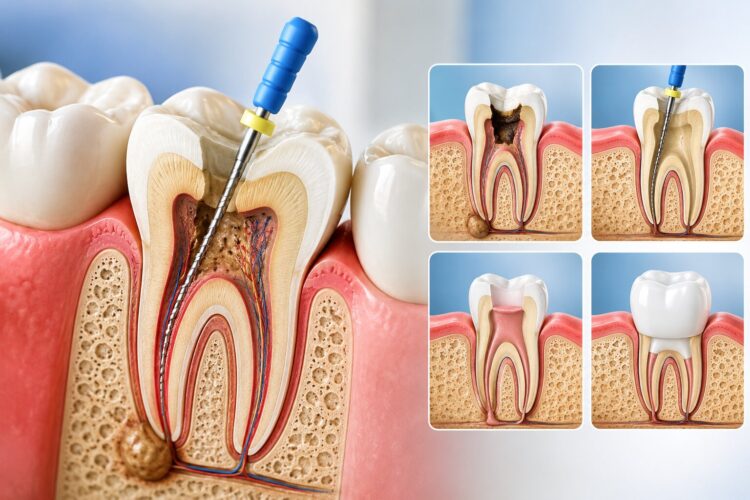
The soft tissue inside the central part of a tooth is called the pulp. The pulp consists of nerves and blood vessels. Root canal treatment may be needed if the pulp becomes infected or badly damaged because of deep tooth decay, cracks, trauma, or other dental problems.
In an RCT the infected/damaged pulp is removed. The internal aspect of the tooth is cleaned, disinfected, filled, and sealed.
Ideally, the source of infection should be removed whilst maintaining the natural dentition.
When Do You Need a Root Canal?
Your dentist may recommend root canal treatment when the pulp inside your tooth is infected or severely damaged.
Common signs and symptoms may include:
- Persistent or severe tooth pain
- Sensitivity to hot or cold that lingers
- Pain when biting or chewing
- Swelling around the tooth
- A dental abscess or pus near the gums
- Discolouration or darkening of the tooth
- Deep tooth decay
- A cracked or damaged tooth
Not every toothache requires a root canal. A dental examination and, when necessary, an X-ray can help determine the cause of your symptoms and the most appropriate treatment.
How Does Root Canal Treatment Work?
At Dentistry At The Cross in Potts Point and Kings Cross, the root canal treatment process generally involves several stages.
1. Dental Examination
Your dentist will examine the affected tooth and may take an X-ray to assess the condition of the tooth, roots, and surrounding tissues.
2. Local Anaesthetic
Local anaesthetic is used to numb the area and help keep you comfortable throughout the procedure.
3. Removing the Infected Pulp
A small opening is made in the tooth to access the pulp chamber. The infected or damaged pulp is then removed.
4. Cleaning and Disinfection
The root canals are carefully cleaned and disinfected to remove bacteria and infected tissue.
5. Filling and Sealing
Once the canals have been thoroughly cleaned, they are filled with a specialised dental material and sealed to help prevent further infection.
6. Dental Crown or Restoration
Depending on the condition of the tooth and the amount of remaining tooth structure, your dentist may recommend a crown or another suitable restoration.
A restoration can help protect the treated tooth and restore its function.
Is Root Canal Treatment Painful?
Pain is one of the most common complaints about root canal treatment.
But, with the introduction of modern techniques and local anaesthesia, the procedure is normally performed wanting to maintain the patient in comfort.
Some mild soreness/sensitivity can occur following treatment. This will generally settle over time.
If you experience severe or worsening pain, severe swelling, or any other symptoms, contact your dentist.
How Long Does Root Canal Treatment Take?
The duration of any root canal treatment will vary for each patient.
The place where the tooth is situated, number of root canals, how complex the tooth is, the amount of infection present- can all affect treatment time.
Some cases can be completed within one appointment, whereas more difficult cases may take several trips.
The dentist at Dentistry At The Cross can give you the treatment plan for your problem once they diagnosed your own dental state.
Benefits of Root Canal Treatment
The main purpose of Root Canal Treatment is to treat infection inside the tooth while helping preserve the natural tooth whenever possible.
Potential benefits include:
- Helps preserve your natural tooth
- Helps treat infection inside the tooth
- Helps relieve pain associated with an infected pulp
- Helps restore normal chewing function
- Can help protect the tooth when followed by appropriate restoration
- May help avoid extraction in suitable cases
What Happens If an Infected Tooth Is Not Treated?
Leaving an infected tooth without treatment may cause it to advance. If left untreated, an infection could result in greater pain, swelling, or a dental abscess.
If your pain continues even after the attack has gone and you continue experiencing pain, heat, or cold sensitivity, swelling, or pain when chewing then you should visit the dentists promptly instead of leaving it.
Early detection may assist your dentist in making a correct diagnosis, allowing treatment to be initiated before it becomes more complex.
Caring for Your Tooth After Root Canal Treatment
Good oral care is important after root canal treatment.
Here are some useful tips:
- Follow your dentist’s post-treatment instructions.
- Avoid chewing hard foods on the treated tooth until advised otherwise.
- Brush twice a day with fluoride toothpaste.
- Floss regularly.
- Attend recommended follow-up appointments.
- If your dentist recommends a crown, have the final restoration completed as advised.
- Maintain regular dental check-ups and professional cleans.
Why Choose Dentistry At The Cross?
At what comes next places in, Potts Point and Kings Cross, Dentistry At The Cross offer dental services aimed at assisting you with maintaining healthy teeth and gums:
If you are still suffering from toothache sensitivity swelling or discomfort when eating, our dentists will be able to examine you and discuss treatment options available.
If you require an examination, preventative dentistry, restorative dentistry or consultation for Root Canal Treatment, it is best to seek professional advice.
Root Canal Treatment in Potts Point & Kings Cross
If you are seeking Root Canal Treatment in either Potts Point or Kings Cross then an examination with a dentist can identify if RCT is suitable for your tooth.
We at Dentistry At The Cross are here to educate the patients of their dental disease and the options available for treatment.
Don’t put up with continuing sensitive teeth or a tooth that always hurts. Book an appointment with your dentist and have your tooth examined and get customized advice.
Conclusion
Root Canal Treatment is a common dental procedure used to treat infection or damage within a tooth while preserving that tooth as far as is feasible.
If you suffer with long term tooth ache sensitivity swelling or problems chewing, then a checkup with your dentist is advisable. It is the best way to find out what is wrong and the best course of treatment.
Patients living in Potts Point and Kings Cross may be interested to visit the Dentistry At The Cross, who are able to carry out an examination and talk through options available to you.
This article is intended only for general educational purposes and should not be used in place of proper diagnosis and treatment. Treatment recommendations are dependent on every patient’s specific dental condition.